
Motor and drive assembly
The motor, internal gears, sprockets, trolley and rail are checked when the operator clicks, hums, grinds or runs without moving the door. Belt, chain and screw-drive systems have different wear points.
Serving Chiefland, Florida
Get help with grinding motors, unresponsive controls, reversing doors, and other opener problems.
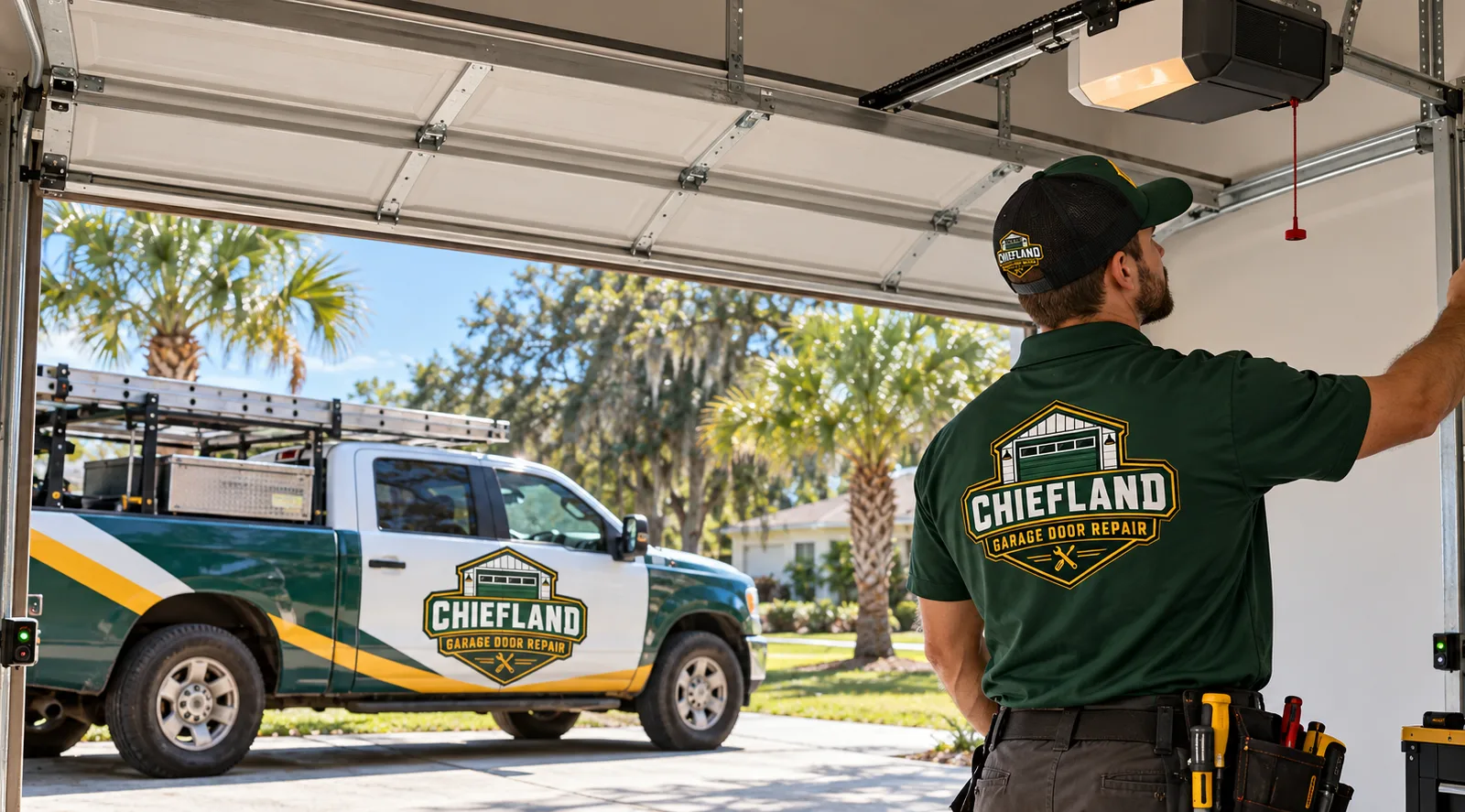
When the door ignores the remote, stops partway or makes a grinding sound, the cause may be in the opener rather than the door itself. Chiefland Garage Door Repair provides garage door opener repair in Chiefland, FL, with attention to the motor unit, drive system, controls, safety sensors and the condition of the moving door.
A useful diagnosis starts by separating an opener fault from a door fault. A disconnected door that is unusually heavy, crooked or difficult to move may have a spring, cable, roller or track problem. Running an opener against that resistance can strain its motor and gears. If the door moves properly by hand, testing can turn to the opener's power supply, travel settings, force settings, control wiring and internal components.
North Central Florida's heat, humidity, storms and airborne debris can affect equipment in a garage. Sensor lenses become dirty, wiring terminals can corrode, and power interruptions may erase remote programming or expose a weak circuit board. Those conditions do not prove which part failed, but they are worth checking during troubleshooting. When the trouble belongs to the door rather than its operator, garage door repair in Chiefland addresses the mechanical system.
A hum or click without door movement can point to a stripped drive gear, a jammed trolley, a failed capacitor or a door that the opener cannot lift. Grinding often comes from worn internal gears or a drive assembly that has lost proper tension. If the motor runs but the door stays still, the trolley may be released, the carriage may be damaged or the drive connection may have failed.
A door that closes and immediately returns upward often has a safety-reversal problem. Photo-eye sensors are mounted near the floor and must face each other across the opening. Dirt, vibration, damaged wire or a bumped bracket can interrupt their beam. A flashing indicator light may help identify the affected sensor, but bypassing the safety system is not a sound repair.
If the wall control works while a handheld remote does not, the likely causes include a depleted battery, lost programming, radio interference or a failed remote. If neither control works, power, lock mode, low-voltage wiring and the receiver or logic board need inspection. These distinctions help avoid replacing a complete operator when a smaller component is responsible.
Testing follows the symptom through the opener's mechanical, electrical, control, and safety systems.
The motor, internal gears, sprockets, trolley and rail are checked when the operator clicks, hums, grinds or runs without moving the door. Belt, chain and screw-drive systems have different wear points.
Sensor position, indicator lights, lens condition, brackets and low-voltage wiring are examined when the door will not close normally or reverses near the floor.
Testing can identify dead batteries, lock-mode activation, damaged buttons, broken wiring, lost programming and compatibility issues with replacement transmitters.
Incorrect limits may cause the door to stop short or hit the floor and reopen. Adjustments should follow the opener's design and should not be used to overpower a binding door.
Power supply, wiring connections and circuit-board behavior are considered after outages, electrical surges or intermittent operation. A reset alone does not correct damaged electronics.
Wireless keypads, external receivers and compatible accessories can be tested and reprogrammed when access codes or control signals stop working.
Step 2 of 6
With the door closed, the operator can be disconnected so the door's balance and movement can be assessed. A door that is hard to lift needs mechanical attention before the opener is tested under load.
Step 3 of 6
Power, wall controls, remotes, photo eyes, wiring, travel limits and reversal behavior are checked. Diagnostic lights and manufacturer error codes may narrow the fault.
Step 4 of 6
The rail, trolley, drive components, gears and electronic controls are examined as the symptoms require. That tells us whether adjustment, reprogramming or a component repair is appropriate.
Step 5 of 6
Parts availability, compatibility, and overall condition determine whether the opener can be repaired or should be replaced.
Step 6 of 6
After service, the opener is cycled with its controls. Travel, stopping position and safety reversal are checked so the system's behavior can be confirmed.
Repair is often reasonable when the opener is compatible with current safety equipment, the required part is available and the rest of the unit operates correctly. A remote, wall button, sensor bracket, wiring connection, gear assembly or travel-setting problem does not automatically require a new motor unit.
The door's size, weight and balance matter when selecting an operator. Horsepower labels alone do not settle the choice. Drive type, rail length, headroom, usage and compatibility with the door all affect fit. A properly balanced door should carry its own weight through the springs; the opener guides movement rather than acting as the lifting system.
Confirm that the opener is plugged in and that the garage circuit has power. Replace the remote battery if the wall button still works, and make sure the wall console is not set to vacation or lock mode. Clean the photo-eye lenses with a soft cloth and look for an object blocking the beam. If both sensor lights are present but one flickers, a bracket may have shifted.
Do not increase the force setting simply to make a struggling opener move the door. Extra force can hide binding rollers, damaged track or a balance problem, and it can interfere with safe reversal. Avoid opening the motor housing or handling springs and cables. Springs store substantial energy, while the opener contains electrical parts and moving gears.
If the door is stuck open, keep people and vehicles clear of the opening. Use the emergency release only when the door is fully closed or securely controlled. A door with a broken spring can drop after it is disconnected from the opener. Record the brand and model number if they are easy to read, and note any flashing lights or error codes. That information can make the initial diagnosis more focused.
A grinding, clicking or unreliable opener rarely fixes its underlying fault on its own. Arrange an inspection to identify the failed component and get a practical repair plan.
CALL NOW: (352) 855-3806Practical guidance about clicking operators, remotes, reversing doors, repair timing, replacement choices, and resets.
A clicking opener may have a failed capacitor, stripped gear, jammed trolley, power problem or door that is too heavy for the operator to move. The door should be closed before it is disconnected for a balance check. In a Chiefland garage, heat and humidity can also contribute to deteriorated electrical connections, so both mechanical resistance and the motor unit need attention.
Intermittent remote operation can often be traced to the battery, programming, radio interference, the remote itself or the opener's receiver. Test whether the wall control remains dependable and whether every remote has the same problem. Chiefland Garage Door Repair can use those results to distinguish an accessory issue from a logic-board fault.
The opener may be detecting an obstruction, losing the photo-eye beam or reaching an incorrect close limit. Clean both sensor lenses and remove anything crossing the opening, but do not defeat the sensors. If the door contacts the floor before reversing, its travel setting or mechanical movement may need adjustment.
Repair usually makes sense when the fault is limited, the needed part is available and the opener has functioning photo-eye protection. Replacement may make more sense for an opener with repeated failures or obsolete electronics. The door must also be balanced and move freely before either option is evaluated.
Yes, but the area should remain clear until the door and opener can be inspected safely. Do not pull the emergency release beneath an uncontrolled door because a broken spring or cable can allow it to fall. The first task is to determine whether the obstruction is inside the opener or in the door's spring, cable, roller or track system.
A reset may restore programming after a power interruption, but it will not repair damaged gears, wiring, sensors, receivers or circuit boards. Florida storms and outages can interrupt settings or expose an existing electronic weakness. If the fault returns after a correct reset, the system needs diagnosis rather than repeated reprogramming.
An inspection of the opener, controls, and moving door can identify the cause and show whether repair or replacement makes sense.