
The Door Feels Extremely Heavy
A properly balanced door should not rely on the opener to carry its full weight. Sudden heaviness often means spring assistance has been lost.
Serving Chiefland, Florida
Get help with a heavy, stuck, or uneven garage door and the right replacement spring.
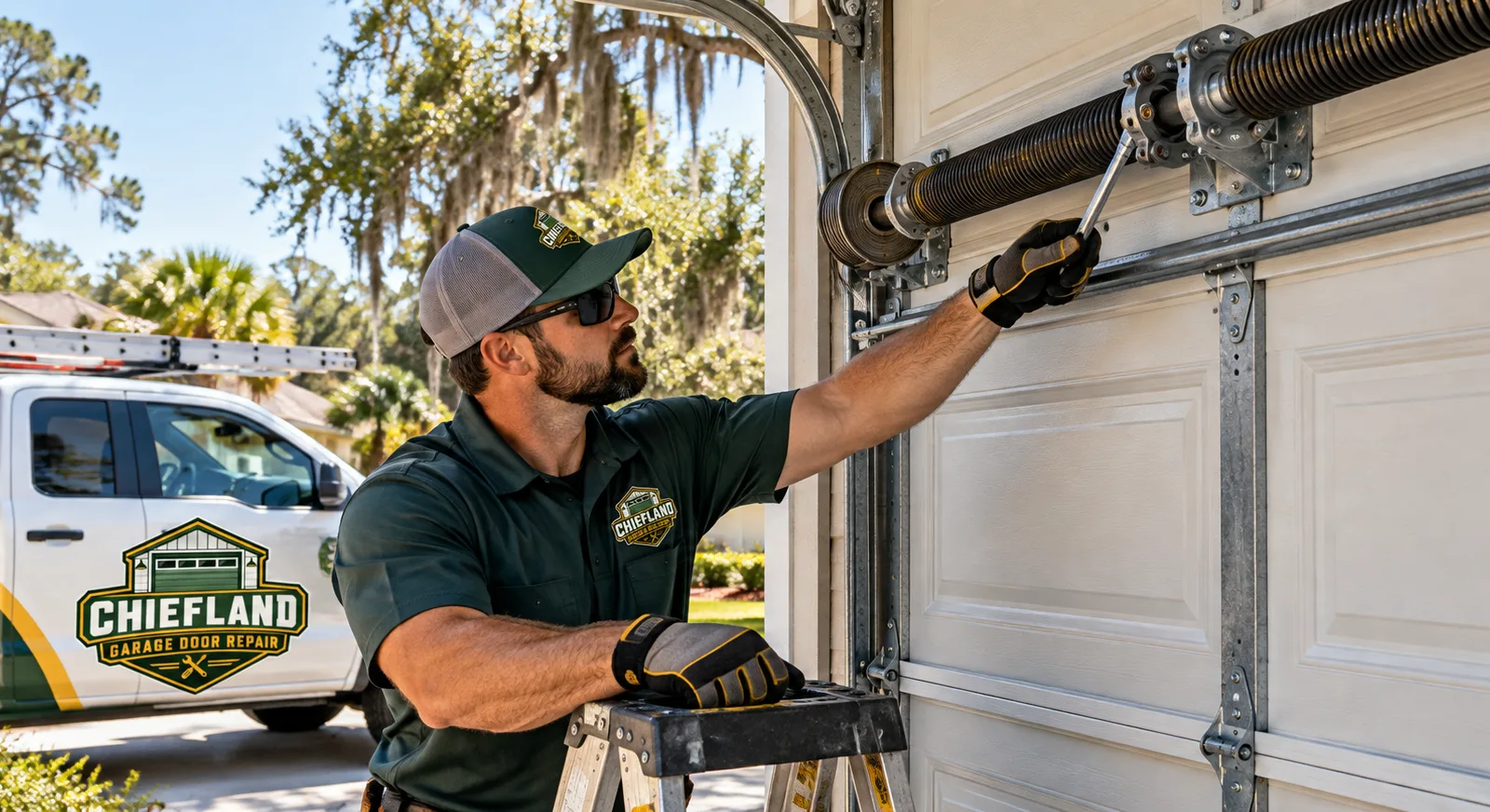
When a door becomes unusually heavy, opens only a few inches, or closes unevenly, a failed spring is a likely cause. Chiefland Garage Door Repair provides garage door spring repair in Chiefland, FL, including diagnosis and replacement of torsion and extension spring systems.
Springs counterbalance the weight of the door. Once one breaks or loses tension, the opener may no longer be able to raise the door safely. Repeated attempts can strain the opener, bend hardware, or let the door move unpredictably. Stop operating the door and keep people, pets, and vehicles clear until the system is checked.
A spring problem does not always look dramatic. A torsion spring commonly leaves a visible gap in the coil after it breaks. An extension spring may hang loose beside the horizontal track. Other signs include a loud bang from the garage, slack lift cables, jerky travel, or a door that feels far heavier than normal when disconnected from the opener. These symptoms need inspection because cable, drum, track, and opener faults can create similar behavior.
Torsion springs sit on a shaft over the door and apply torque through cable drums. Extension springs stretch along the horizontal tracks and use pulleys and cables to assist movement. The two systems require different parts and adjustment methods, so the existing setup must be identified before replacement.
A replacement should match the door rather than simply resemble the broken spring. Door weight, height, track arrangement, drum type, wire size, inside diameter, and spring length can all affect the correct selection. Added insulation, glass, reinforcement, or prior door modifications may also change the required spring rating.
Chiefland Garage Door Repair checks the counterbalance system, installs the appropriate spring configuration, sets tension, and tests door balance and travel. Related components such as bearings, cables, drums, pulleys, and spring anchors are checked for wear or damage that could interfere with safe movement.
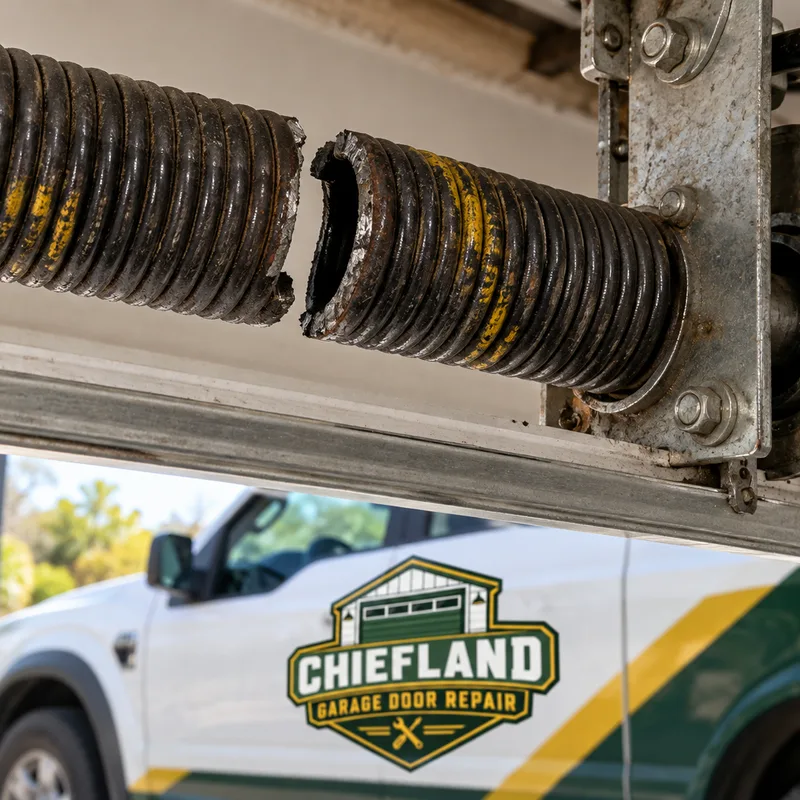
Changes in door weight, travel, cable tension, and spring appearance can indicate a counterbalance failure.
A properly balanced door should not rely on the opener to carry its full weight. Sudden heaviness often means spring assistance has been lost.
The motor may hum or move the door only a short distance because an opener is not designed to replace the lifting force of a working spring.
A visible separation in the coil usually indicates that the spring has broken and can no longer apply torque to the shaft.
Uneven movement can come from a failed extension spring, a cable problem, or another imbalance. Continued operation may pull rollers or tracks out of alignment.
Lift cables can lose tension when a spring fails. Do not handle or wind loose cables because other parts of the system may remain under force.
A spring can release stored energy with a sharp sound. Inspect from a safe distance and avoid trying the door repeatedly.
Step 1 of 4
The door position, material, approximate size, and visible spring location help identify the failed parts.
Step 2 of 4
The spring type, door balance, cables, drums or pulleys, tracks, rollers, and mounting points are checked. This separates a broken spring from an opener, cable, or hardware fault.
Step 3 of 4
The replacement is selected for the door's weight and hardware. Torsion springs are wound to the required tension, while extension systems are fitted and connected with the correct cable arrangement.
Step 4 of 4
The door is moved through its travel and checked at different heights. Final testing confirms that it moves evenly, stays reasonably balanced, and works correctly with the opener.
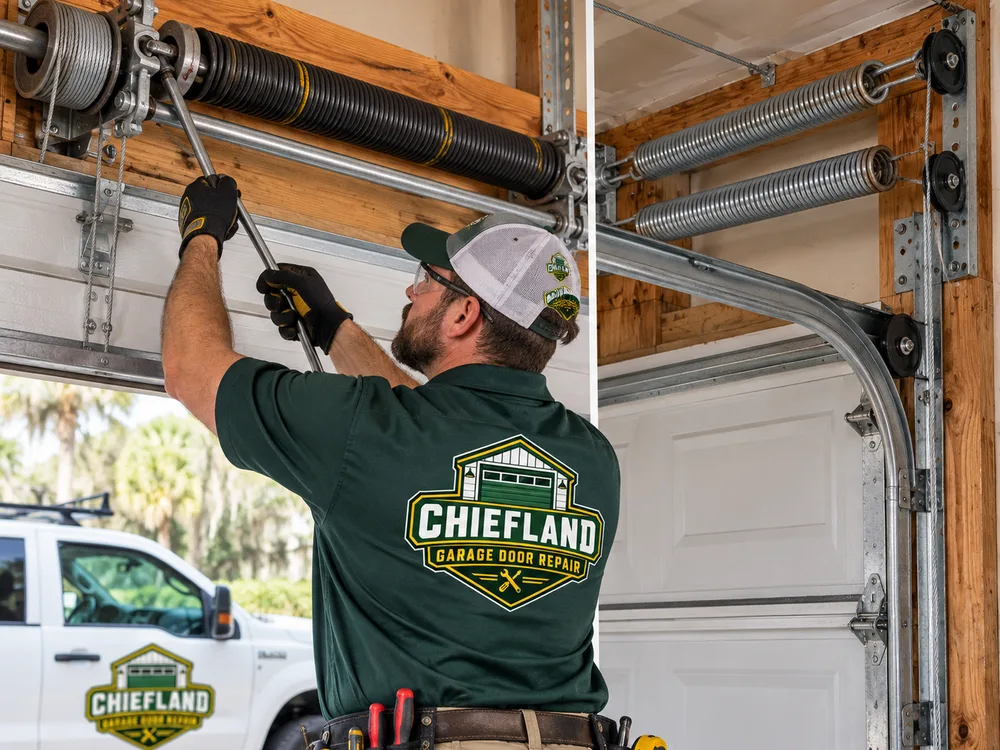
Garage door springs store substantial mechanical energy. Torsion springs require correctly fitted winding bars and controlled adjustment at the winding cone. Extension springs can recoil if a spring, cable, pulley, or anchor releases. Improvised tools, uncertain spring sizing, or an unsupported door can cause serious injury and property damage.
Do not loosen set screws, cut cables, touch a displaced winding cone, or attempt to force the door. If the door is stuck open, keep the opening clear and avoid standing beneath it. If it is closed, do not keep cycling the opener. A red emergency-release cord disconnects the opener trolley; it does not make a springless door lightweight.
If inspection shows that the spring is working and another component caused the failure, broader garage door repair in Chiefland may be appropriate. The goal is to identify the failed part before replacing anything.
Chiefland's warm, humid climate makes routine visual checks worthwhile. Moisture can contribute to surface corrosion on springs, cables, fasteners, and bearings, especially where garage air stays damp or wind-driven rain reaches the opening. Corrosion does not prove that a spring is about to fail, but pitting, frayed cable strands, or deteriorated attachment points deserve attention during an inspection.
Do not coat tracks or spring assemblies with heavy grease. Garage door hardware has specific lubrication needs, and excess product attracts grit. A technician can identify appropriate lubrication points while checking balance and movement.
Spring service should also account for how the garage is used. A frequently operated primary entrance accumulates cycles faster than a door opened occasionally. Spring life is rated in cycles, with one full opening and closing counted as one cycle, but actual service life varies with sizing, use, corrosion, door balance, and installation.
A broken spring leaves the full door weight unsupported by its counterbalance system. Arrange an inspection before the opener or other hardware is put under more strain.
CALL NOW: (352) 855-3806Practical guidance about broken springs, replacement choices, correct sizing, and safe door operation.
It is safer to leave the door in place until the spring system is inspected. A broken spring can make even a standard residential door unexpectedly heavy, and lifting it may allow the door to fall or cause cables to leave the drums. If a vehicle is trapped, tell Chiefland Garage Door Repair when describing the problem.
Paired springs are often considered together because they usually have similar age and cycle history, but the right choice depends on the system's condition and specifications. The technician should inspect both springs, verify the door weight and spring match, and explain whether replacing one or the pair is appropriate.
The opener should not be used to lift a door with a broken spring. The spring system counterbalances the door's weight, while the opener controls movement. Repeated operation may damage the trolley, rail, gear, or mounting hardware.
The correct spring is selected using the door's weight and the counterbalance system's specifications. For torsion systems, relevant measurements can include wire size, inside diameter, spring length, wind direction, drum type, and door height. Matching by appearance alone is unreliable.
Early failure can be associated with incorrect spring sizing, poor balance, corrosion, damaged hardware, or an installation problem. An inspection should consider the entire counterbalance system rather than replacing the broken part without checking cables, drums, bearings, anchors, and door weight.
A spring with a fractured coil is replaced rather than joined or patched. The replacement must be matched to the door and adjusted as part of the complete counterbalance system. If the spring is intact, testing may reveal that tension, cables, pulleys, or other hardware caused the symptoms.
Tell Chiefland Garage Door Repair what the door is doing, whether it is stuck open or closed, and what you can see around the spring. That information helps start the repair with the right diagnosis.